Commercial Door Openers & Operators
Commercial Operators
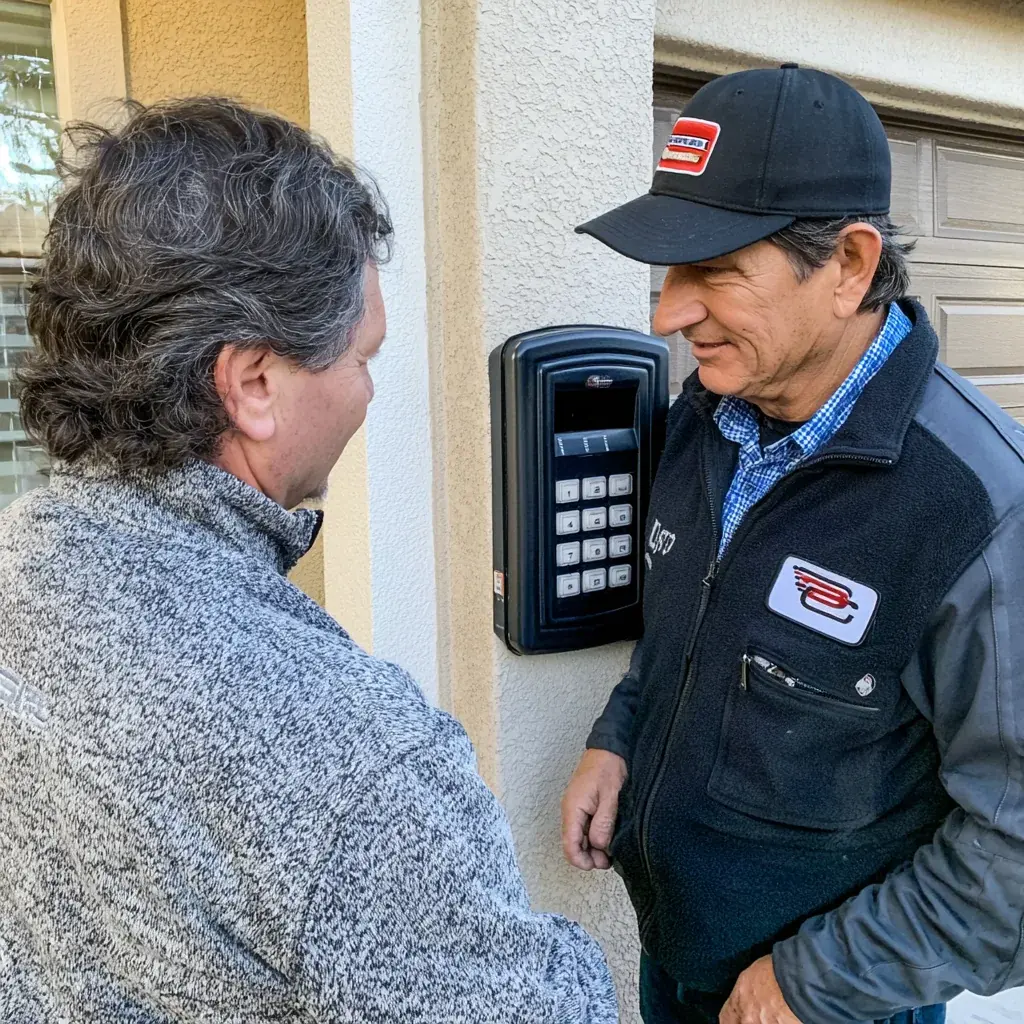
Curtain, barrel, and guide systems built for repeat cycling in Carlsbad warehouses and dock bays.
A commercial roll-up opener is matched to the curtain's weight and duty cycle, not picked by horsepower alone. Jackshaft units mount beside the barrel for low headroom, trolley units suit lighter curtains, and hoist operators run heavy or fire-rated doors through continuous cycling.
A commercial roll-up door in Carlsbad answers to a schedule, not a mood. A service bay at the Carlsbad Research Center, a delivery door behind Carlsbad Premium Outlets, a shop roll-up off Palomar Airport Road all move on a curtain of interlocking slats, not a single rigid panel, and that curtain is the whole argument for how the door fails and how it gets fixed.
The curtain winds onto a barrel above the opening, and the barrel holds the counterbalance spring that carries the door's weight. Buildings along Faraday Avenue and near Palomar Airport run that barrel through dozens of cycles a shift, which wears the spring and bearings faster than a house door ever sees, whether the tenant is light-industrial, office, or biotech space.
Cycles per day, curtain weight, and headroom above the opening are the numbers that decide which operator and spring size a Carlsbad building actually needs. A loading door near the Village Industrial Corridor running heavy freight all day calls for different hardware than a retail roll-up near Carlsbad Village Drive that closes once at night.
A jackshaft operator mounts on the wall beside the door and turns the barrel directly, which keeps the ceiling clear over the opening. That fits low bays with ductwork or sprinkler lines already crossing overhead, a common condition in the tighter buildings around the Carlsbad Research Center.
A hoist or chain-drive operator instead lifts the curtain from above, usually where headroom allows a motor mounted over the hood that shields the coiled curtain when the door sits open. Retail and light-industrial bays near Palomar Airport Road often use this setup because the layout leaves room for it.
| Symptom | Likely Cause | Why It Matters |
|---|---|---|
| Trolley operator | Lighter curtains, standard bays | Light to medium duty cycle |
| Jackshaft operator | Low headroom near the hood | Mounts beside the barrel |
| Hoist operator | Heavy or fire-rated curtains | Continuous or heavy duty cycle |
| Power feed | Single-phase for a light curtain | Three-phase for all-shift running |
| Control station | Wall-mounted open, close, stop buttons | Limits who runs the curtain |
| Interlock switch present | Cuts power if the guide isn't seated | Matters where bays sit in a row |
| Curtain wanders in the guide | Guide angle bent or worn out of square | Slats bind and chew the endlocks over time |
| Barrel sags at mid-span | Bracket or bearing wear from years of coiling | Uneven wind stresses the spring and the welds |
Guides on either side of the opening keep the slats tracking straight as the curtain travels, and a bent guide from a forklift strike or a delivery truck backing in wrong will bind the door long before the spring or motor takes any blame. Endlocks fastened to the slats ride inside those guides and keep the curtain from walking sideways.
Duty cycle is the manufacturer's rating for how many times an hour and how many hours a day an operator can run without overheating or wearing out early. A roll-up sized for a slow retail bay near Carlsbad Village Pier will not hold up on a warehouse door cycling constantly near the Village Industrial Corridor.
Interlocks are the wiring that stops the operator from running while a side service door or gate stands open, and they matter more on a coiling door because the barrel and spring keep enough stored energy to move the curtain fast if something overrides the lockout. A building manager should know whether that safety wiring is even present.
Carlsbad's commercial roll-up doors sit on very different buildings. The Carlsbad Research Center along Faraday Avenue holds R&D and light-industrial tilt-up construction, while warehouse and shop space near El Camino Real and Palomar Airport Road runs different cycle counts entirely. A curtain that opens forty times a day near Palomar Airport wears on a different schedule than one opening four times a day in a quiet Bressi Ranch bay.
A lab or office bay near Palomar Airport might roll its door a few times a day for deliveries, while a light-industrial shop off College Boulevard runs its curtain dozens of times a shift moving materials and vehicles. Those two doors wear at completely different rates even if they look identical closed.
A tenant near the Village Industrial Corridor who can't roll up a bay door isn't scheduling a repair, they're losing a morning of deliveries or a service bay that can't turn cars. A stuck curtain on a roll-up blocks the opening completely in a way a sectional door's separate panels sometimes don't.
A written record of the operator model, duty cycle rating, and last service date turns a jammed curtain near Faraday Avenue into a short diagnosis instead of a technician guessing at spring tension and barrel wear from scratch. Facilities contacts who keep that record get back open faster.
Carlsbad doesn't put a hard freeze on a spring or barrel, so a coiling door here wears out from cycle count, corrosion, and age rather than cold-stiffened grease or a chain that seizes overnight. That shifts the maintenance conversation toward lubrication and bearing wear over anything winter-related.
Salt air off the coast decides the maintenance schedule more than the calendar does. A roll-up running near Carlsbad State Beach or Tamarack Point sees faster corrosion on guides, endlocks, and the barrel's bearings than the same door set back near El Camino Real, so the service interval should track distance from the water, not just months on a sticker.
Carlsbad does not publish a blanket permit exemption for commercial roll-up work, so each job gets checked on its own terms. A motor swap on an unchanged opening near the Carlsbad Research Center usually stays routine, but altering the curtain, barrel, or guide track moves into work the City of Carlsbad Building Division may want documented, and any job at or above the state's contractor threshold requires a licensed C-61/D-28 contractor regardless of address.
Coastal moisture doesn't fall as rain most of the year here, it just hangs as marine layer and settles on anything metal overnight. A track that stays damp past sunrise starts to spot before the owner ever notices, and that spotting works into the roller path long before the door itself acts any different.La Costa Oaks, La Costa Valley and Aviara. Springs don't announce themselves before they go. One winds down slowly under daily tension until the day it simply can't lift the weight anymore. The other snaps outright, usually on a cold morning after months of quiet strain nobody noticed building.
Foundation type shapes how a garage door ages. Slab-on-grade homes keep the track fixed to a floor that barely moves, but expansive clay under some mesa lots settles slowly, tilting the frame and pulling rollers off true over several years, not overnight.This estimate covers a single attached door on a typical Carlsbad slab foundation, from Olde Carlsbad to the newer Bressi Ranch tracts. Wider doors, tandem bays, or units facing salt air near Tamarack Point often run higher. Custom wood, second detached structures, or heavy insulated panels change the math too. Full guide bands are on the pricing guide, and the commercial overview covers how a scheduled program works.
Commercial Operators
For Warehouse Managers
Multi-Unit & HOA
Usually not. Replacing an existing operator with a comparable unit on the same opening, on a bay along Palomar Airport Road or Faraday Avenue, typically stays inside routine maintenance. Changing the opening size, adding a control station, or altering the curtain or guide track is different work, and Carlsbad's Building Division should be the one to say whether it needs a permit before anyone starts.
Horsepower is how hard the motor pulls the curtain up the guide. Duty cycle is how many times an hour it can do that before the windings heat up and the operator shuts itself down. A dock door near Carlsbad Research Center cycling all shift needs the second number sized right, not just the first.
It depends on the operator, not the building. Some hoist and heavier jackshaft units on wider bays near the Carlsbad Research Center run on three-phase power because it handles frequent cycling better than single-phase. A licensed electrician should confirm what actually feeds the panel before any operator gets ordered.
It's a safety switch wired into the control station that keeps the operator from running until a door, slide bolt, or adjoining gate has fully seated. On a fire-rated curtain, that check matters most, since a partial seat in the guide defeats the rating even if the door looks closed from the floor.
If a roll-up door off Palomar Airport Road or Faraday Avenue is stuck mid-curtain, call and describe the barrel, guides, and what the control station is doing.
Call (760) 392-8678