Extension Springs and Safety Cables in Carlsbad
How stretch springs lift older Carlsbad garages, and where safety cables come in.
Extension springs run above the horizontal track and lift the door by stretching, not twisting on an overhead shaft. Carlsbad still has them on older single-car openings in Olde Carlsbad and near the Village, usually paired with a pulley and cable.
What The Stretch Actually Does
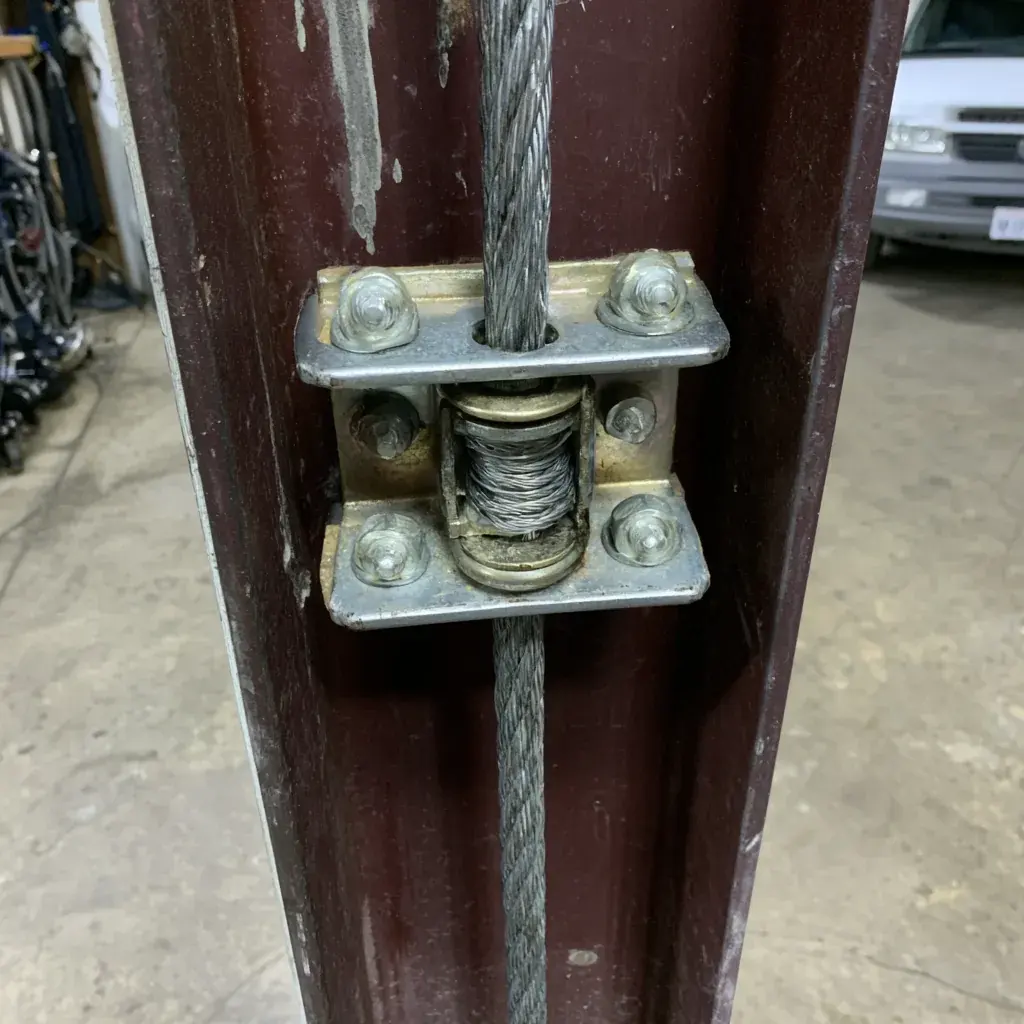
An extension spring sits on top of each horizontal track in a Carlsbad garage, and it works by stretching. As the door lowers, the spring elongates and stores the pull needed to bring the door back up. That stretching action is the whole difference from a torsion spring: no shaft, no drum, just a coil reaching its length limit near full extension. A cable threads through the coil's center and runs over a pulley to an S-hook, which is exactly what a safety cable is meant to run through if that coil ever lets go.
Each spring hooks to a stationary bracket at the rear of the track, then a lift cable runs forward over a pulley mounted near the front, down to the bottom bracket at the door's edge. The pulley carries the direction change, not the load; the spring itself supplies the lift. Two matched springs work independently on either side, so a garage door repair call in Carlsbad often finds one side stretched further than the other, a sign the pair is aging unevenly.
The visible difference is motion. A torsion spring stays fixed to its shaft and barely appears to move while the door travels, since the shaft twists in place above the opening. An extension spring is doing the opposite job in plain view: it lengthens as the door comes down and shortens as it rises, right along the track where anyone changing a lightbulb in the garage would see it. No hidden shaft, no twisting bar overhead.
What the Safety Cable Prevents
A safety cable is a separate, thinner cable run through the coils of the extension spring, fastened at its own two points and carrying no connection to the pulley or the lift cable. It sits idle during normal opening and closing. Its only job is to hold the spring's two halves in roughly the same place if the coil itself breaks apart.
That break is not an unusual event for an extension spring. The coil spends its working life stretched near the top of its rated range, doing that same trip every time a car pulls out for El Camino Real or Palomar Airport Road. Years of that cycling fatigue the steel, and when a coil finally separates, the two halves are free to travel.
Without a working safety cable, a broken extension spring becomes a projectile instead of a dead weight. The coil can snap free at speed and travel the length of the track, and the door itself can drop hard enough to dent a car roof or catch a hand reaching for the release. The cable's only job is to keep the spring's path short and predictable, holding it near the track it came from rather than letting it launch into the garage.
How Extension Springs Behave
A torsion spring usually gives some notice before it fails, a slow loss of lift over weeks or a sharp bang from the shaft. An extension spring tends to go without that warning, since the stretched coil holds tension right up to the moment it separates, and a Carlsbad homeowner in Olde Carlsbad or Rancho Carrillo is more likely to find the door simply stuck partway.
Extension systems carry moving parts a torsion setup skips entirely. Each spring pulls a lift cable over a pulley, and that cable ends in an S-hook looped through a bracket or the spring itself. The pulley wheel wears in its own groove over enough open-close cycles, and an S-hook can stretch open slightly, spin loose, or slip off its anchor point. None of those parts exist on a torsion shaft, which is one reason a straight conversion changes more than the spring alone.
Is a Torsion Conversion Worth It
Converting a Carlsbad garage from extension to torsion swaps the pulleys, cables, and S-hooks for a single shaft centered above the opening, and headroom above the track decides whether it fits. Older homes in Carlsbad Village and Olde Carlsbad, built with less clearance than newer La Costa Oaks or Bressi Ranch construction, are where this question comes up most, since a torsion shaft needs several inches a tight header may not have.
Where the clearance exists, a torsion shaft replaces the extension system's exposed, stretched coils with one that sits still and turns instead. It removes the pulley, the S-hooks, and the safety cable as separate points of wear, consolidating the lifting mechanism into a single shaft assembly. Newer builds in places like La Costa Oaks or Aviara were framed with that clearance from the start, which is part of why torsion became the standard mount there and extension systems stayed more common on older Carlsbad stock.
Extension Spring Basics
- Extension springs stretch along the track; torsion springs twist on a shaft above the opening and need more headroom to install.
- A safety cable runs through the coils and anchors at both ends, catching the spring if it snaps under stretch.
- Smaller single-car garages in Olde Carlsbad and around the Village, built before torsion hardware became the norm, are the ones most often found with extension springs and open pulleys instead of a shaft.
- Low headroom above the opening is the original reason these garages got extension springs instead of torsion. A shaft and centered end brackets need clearance many older Carlsbad garages never had.
- Switching to torsion means adding a center shaft, bearing plates, and drums above the opening, not just trading one spring type for another. Low headroom near the header can limit where those parts fit.
- Salt air off the coast near Carlsbad Boulevard and Tamarack Avenue reaches an unprotected S-hook or pulley bracket faster than it reaches the coil, so that connection point often gives out first.
Frequently Asked Questions
Why are my garage springs mounted on the sides?
Yes. Extension springs mounted along the track are common on older Carlsbad garages, particularly single-car openings in Olde Carlsbad and parts of Carlsbad Village that predate torsion hardware becoming the standard setup. Newer construction in areas like La Costa and Bressi Ranch was largely built with torsion systems from the start, so extension springs there are less common but still turn up occasionally depending on the builder.
Why does my extension spring have a cable through the middle?
That's the safety cable. It runs through the coil and anchors at each end separately from the spring's own mounting, so it carries no load while the door operates normally. If the coil breaks, the cable keeps the two halves from flying loose, which is why federal rule has required it on residential extension spring setups since the 1970s.
Should I convert my extension springs to torsion?
Open the door and look along the horizontal track. A visible spring stretched out along the track means an extension system is still in place. If instead you see a round tube spanning the top of the opening with springs wound around it and no stretched spring near the track, the door has already been converted to torsion.
Ready for a spring conversion quote?
A cable-less or aging extension spring near Olde Carlsbad is worth a second look. Ask about a torsion swap before the coil goes.
Call (760) 392-8678